
500 MCM Copper Wire for AI Data Center Power Distribution
Over the past several years, International Wire has seen significant growth in copper conductor demand tied to commercial construction, particularly the rapid buildout of AI and hyperscale data centers.
These projects require enormous volumes of copper conductors across a wide range of sizes and configurations—and specifications continue to evolve as data center power requirements increase. BloombergNEF is predicting that AI-powered data centers will consume an average of roughly 400,000 metric tonnes of copper conductor annually over the next decade. International Wire is already supporting this build cycle with the manufacturing scale, conductor range, and production flexibility required for high-volume power infrastructure projects.
Understanding Data Center Power Distribution
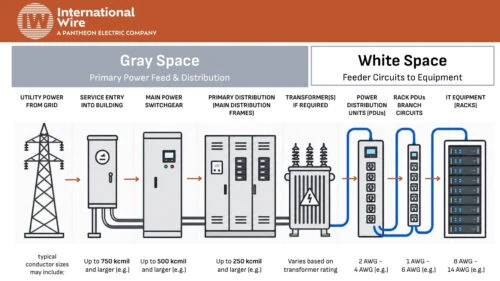
In a data center, gray space and white space distinguish the supporting electrical and mechanical infrastructure from the areas where IT equipment operates. At International Wire, we use these terms as a simple shorthand for two areas of data center power distribution.
- Gray space contains the infrastructure required to power, protect, and cool the data center, including transformers, switchgear, UPS systems, generators, energy storage, and mechanical equipment. From a conductor perspective, this is where larger conductors typically support major power distribution.
- White space is the computing environment where servers, storage, and networking equipment operate. Here, power is distributed closer to the IT equipment through systems that can include busway, busbar systems, rack PDUs, and associated cabling.
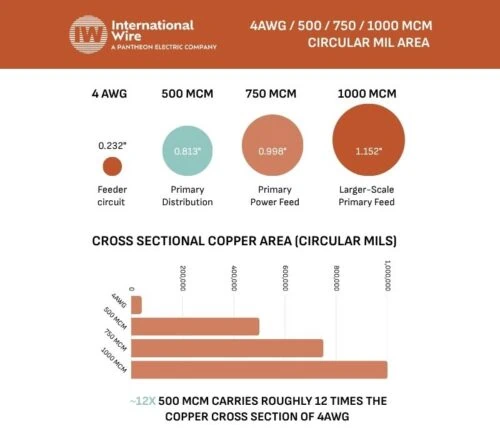
International Wire serves conductor requirements across both areas, but our greatest volume advantage is in the larger conductor sizes frequently used in high-capacity power distribution. These can include 500 MCM and 750 MCM conductors, while smaller sizes may be used further downstream depending on the electrical design. The difference in conductor size is substantial. A 500 MCM conductor has roughly 12 times the copper cross-sectional area of a 4 AWG conductor.
At the scale of a hyperscale data center, those pounds of copper add up quickly. This is where throughput, manufacturing capacity, and project scale come together—and exactly where International Wire is built to perform.
Why 500 MCM Copper Wire Matters
500 MCM wire has become one of the conductor sizes we produce most frequently for large power-distribution applications. While the size itself is well established, growing data center and infrastructure demand has significantly increased the volumes moving through our plants. It’s common enough that when a customer asks for an old, 1950s-era size like a 400 or 450 MCM, we usually point them toward 500 MCM instead because it has the same purpose, more power, longer service life, and it’s already running in daily production.
International Wire manufactures 500 MCM copper wire, 37-strand, essentially every day, with redundant production capability across three plants. For customers managing large projects, that provides greater manufacturing flexibility than relying on a single production location.
| Size | Circular mil area | Overall diameter (stranded copper) | Typical role in a data center |
| 4 AWG | 41,740 CM | 0.232″ | Smaller feeder circuit applications (white space) |
| 250 MCM | 250,000 CM | 0.575″ | Power distribution and feeder circuit applications (white space) |
| 500 MCM | 500,000 CM | 0.813″ | Large power-distribution applications (gray space) |
| 750 MCM | 750,000 CM | 0.998″ | High-capacity power distribution (gray space) |
| 1000 MCM | 1,000,000 CM | 1.152″ | Larger-scale primary power distribution (gray space) |
Flexible or Rigid: Data Center Conductor Designs Are Still Evolving
As data center power requirements grow, cable manufacturers and system designers are evaluating different conductor constructions to balance electrical performance, flexibility, installation requirements, outer diameter, and cost.
We’re seeing data center conductor design split two ways:
- One path is flexible wire, which is a higher-strand-count construction, generally bare copper, designed for ease of install. It costs more at the start of a project but saves time and labor costs associated with pulling cable through a live construction site.
- The other path is more outer diameter and rigidity-driven, built simply to carry enough power efficiently through the distribution run.
We expect some consolidation in design standards as the market matures, but for now, both approaches are very much in play, and manufacturers who can produce flexible wire or a rigid construction on short notice have the advantage, and that’s exactly where we’ve focused our process capability.
Built to Move Fast When the Specification Changes
International Wire is the largest non-vertically-integrated copper wire manufacturer in the country, and our business is designed around flexible, made-to-spec production. That capability becomes increasingly important as cable manufacturers respond to rapidly changing requirements in data centers and other high-growth electrification markets.
When a conventional manufacturing method creates a capacity, dimensional, or cost constraint, our engineering teams can evaluate whether another production process can manufacture the required construction without compromising the customer’s specification. That may mean evaluating different equipment, running a trial reel, measuring the resulting conductor against customer tolerances, and determining whether a new production method can be scaled.
Recently, a cable manufacturer building out its own in-house production had won a large bare copper rope construction portable power opportunity which called for a medium voltage cable with a high strand count . This kind of product is traditionally fabricated in a process that is reliable but slow. They were under pressure on both capacity and price, and needed a partner who could produce the same construction without cutting corners on the spec.
Rather than quote it the traditional way, our engineering team looked at whether the construction could be fabricated in another production cell being utilized for servicing different strand conductor configuration. The solution wasn’t obvious, and when the customer’s own engineers ran the numbers, they came back and said the outer diameter would likely be too large for their tooling. We could have stopped there and quoted it the slow way. Instead, we decided to run a trial reel to find out if the new process would work in place of the slower historical method, and it came in within their tolerance. That trial opened another production path for the customer and helped turn a challenging specification into an order that continues to ship today.
What Data Center Scale Actually Looks Like
The defining characteristic of the data center opportunity isn’t simply conductor size. It’s volume. A single hyperscale data center campus project might spec a mid-600 MCM tin-plated copper rope cable, and that alone could mean volume large enough to run a dedicated production line for months at a stretch, across multiple buildings, and then a repeat order a couple of years later as the campus expands. These aren’t one-time purchase orders; they’re six-month to year-long build-outs where we’re shipping continuously, and the campuses that started as four buildings are coming back for more.
For conductor manufacturers, supporting that scale requires more than the ability to make a particular wire size. It requires sustained throughput, manufacturing redundancy, and the flexibility to respond as project schedules and specifications evolve. This is where International Wire’s manufacturing footprint becomes particularly important.
With production capabilities distributed across multiple facilities, large-volume requirements don’t have to depend entirely on the schedule or capacity of a single plant. That manufacturing redundancy gives customers another layer of supply flexibility as projects scale.
Investing Ahead of Data Center Demand
We expect AI and data center demand to continue growing, and International Wire is investing in manufacturing capacity to support that growth. For customers, the question isn’t simply who can manufacture the specification the cheapest. It’s who can deliver the required volume, consistently, when the project needs it.
International Wire combines three capabilities that are becoming increasingly important as data center power requirements grow:
- Scale: Manufacturing capacity designed to support sustained, high-volume conductor requirements.
- Redundancy: Production capabilities across multiple facilities to provide greater supply flexibility.
- Manufacturing flexibility: The engineering and process expertise to respond as conductor specifications and project requirements evolve.
If you’re spec’ing conductor for a data center or large-scale power distribution project, send us the specification, including the parts you haven’t finalized yet, or the parts your own team’s math says won’t work. Sometimes the only way to know is to run the trial reel.
Planning a data center or large-scale power distribution project? Send us your conductor specifications—even if the design is still evolving. Our engineering and manufacturing teams can help evaluate construction options, production feasibility, and scale-up requirements.
Talk to our team about your next project today.
Common Questions About 500 MCM Wire
What does “MCM” mean, and what gauge is 500 MCM wire?
MCM stands for one thousand circular mils which is a sizing system used once a conductor is too large to describe with a standard AWG gauge number. Today, the equivalent term kcmil is commonly used in electrical standards. A 500 MCM (500 kcmil) conductor has a cross-sectional area of 500,000 circular mils, which is larger 4/0 AWG, the largest standard AWG conductor size.
What’s the difference between 500 MCM and 750 MCM copper wire?
750 MCM carries 50% more copper cross-sectional area than 500 MCM and has a larger overall diameter, which means higher current-carrying capacity. In data center power distribution, 750 MCM is typically used for the primary feed, with 500 MCM handling distribution further down the line.
Who manufactures 500 MCM copper wire in the US?
International Wire manufactures 500 MCM copper wire in the United States, with redundant production capability across multiple U.S. plants. This manufacturing footprint helps support the sustained volumes required for large data center, commercial construction, and power-distribution projects.
Why is 500 MCM copper wire used in data center power distribution?
Large data centers require substantial amounts of electrical power to operate servers, cooling systems, networking equipment, and supporting infrastructure. Larger copper conductors, including 500 MCM, can be used in high-capacity power-distribution applications where the electrical design requires their conductor size and ampacity. The specific conductor size and construction depend on the system design and installation requirements.

